1: In brief
In brief
The Lancia Ypsilon Sport MomoDesign makes its entrance, with the most powerful diesel engine in its class, a new version with a split personality (a dynamic look and innate elegance), which opens a new chapter in the collaboration between two brands that are famous throughout the world for their contribution to Italian industrial design.
Lancia and MomoDesign have created a very personal stylistic language which makes their creations stand out among so many mass-produced products. This is borne out, for example, by the exclusive items of clothing and accessories designed and developed by the MomoDesign Styling Centre: helmets, watches, sunglasses, shoes and leather goods. They are unique products in the fashion world, just as Lancia creations are unique in theirs. In this sense, the new Ypsilon Sport MomoDesign is an example of how an �automotive object� can be reinterpreted from a stylistic viewpoint with another brand, highlighting the expressive features that have always distinguished Lancia: elegance and attitude.
With the new Sport MomoDesign version, the new Ypsilon extends its range to appeal to young drivers who are looking for a sporty car at an accessible price, that provides emotion at the wheel but still maintains all the elegance and distinction that are the reason for the success of Lancia�s compact.
On the outside, the car sports the new Lancia logo and a number of stylistic and chromatic features typical of products from MomoDesign, for example the four bodywork colours (Masaccio Black, Borromini Grey, Casorati Yellow and Raphael White), combined with the exclusive opaque Titanium Grey of the tailgate, the roof and the wing mirrors. The �outfit� of the Ypsilon Sport MomoDesign is completed by burnished metalluro finishing details on certain elements, fog lights with colour-coded frames, black tone-on-tone �MomoDesign� graphics on the central pillar and original 16� diamond effect burnished alloy wheels. The same sporty styling is evident inside, where the dark paneling of the passenger compartment sets off the black of the technological Airtex fabric on the seats and the leather of the steering wheel and gear lever knob, and the Ypsilon logo on the head-restraints adds an elegant touch. And for extra sportiness the seats can be upholstered with Leather and Alcantara� Starlite, with perforations through which a silver �MomoDesign� is visible.
Whoever loves driving will find that the compact new Ypsilon Sport MomoDesign guarantees sparkling performance on every road, providing great sensations for the driver and passengers, thanks to the low suspension and disc brakes front and rear.
Where the engines are concerned, the most assertive is the sparkling 1.3 Multijet 16V which delivers 105 bhp at 4000 rpm and 200 Nm (20.4 kgm) of torque at 1750 rpm. With this engine and a 5-speed gearbox, the car has a top speed of 177 km/h and accelerates from 0 to 100 km/h in 10.5 seconds. Excellent performance that makes this car the most powerful compact in its class. In spite of which consumption and CO2 emissions are low, as they are on the entire Multijet range: 4.7 l/100 km in the combined cycle and 123 g/km.
The Sport MomoDesign range will include a petrol version with a 1.4 16v engine that delivers 95 bhp, which is more entertaining to drive, thanks to a 6-speed manual gearbox (the sequential, robotised DFN gearbox is also available). And finally, motorists who wish to combine the handling of a sports car with respect for the environment in a compact, are offered the 90 bhp 1.3 Multijet 16v, which fits the DPF particulate filter as standard equipment.
The most striking characteristics of the Lancia Ypsilon Sport MomoDesign are its original styling and excellent performance. But it is also lavishly equipped: climate control, �Dual Drive� electric power steering, Hi-Fi radio-CD player, remote control door opening and closing, Follow me home device, dark rear windows, perforated leather upholstery on the steering wheel and gear lever knob with silver overstitching. On the outside, the car has diamond-effect burnished 16� alloys and colour-coded twin electric wing mirrors. In the safety field, the new Ypsilon Sport MomoDesign is equipped with ABS complete with EBD, front airbags and curtain-bags (sidebags are available as an option) and the sophisticated ESP system with ASR and a Hill Holder. The lavish array of equipment also features electric front windows, a split, folding, tilting rear seat and a steering wheel that adjusts for height and reach. And finally, there is a long list of optional equipment that includes the GranLuce sunroof, dual zone automatic climate control, a Bose� sound system, a satellite navigator and the Blue&Me� system.
At a later date, a rear spoiler will also be available, the ideal solution to make this sporty compact look even more aggressive.
The Ypsilon Sport MomoDesign will go on the market in Italy in mid June, and will gradually strengthen the new Ypsilon range on all the other markets.
The new Sport MomoDesign version obviously inherits all the distinction and prestige inherent in the new Ypsilon, a car that combines the excellence of the styling with cutting-edge technology. Just like all the best Italian luxury products, names that are famous throughout the world. The new Ypsilon was designed and developed for a clientele that likes to stand out with exclusive products, and for whom a car must be first and foremost a pleasure to use. And like all the best Italian luxury products, the new Ypsilon exudes stylistic refinement, perfect colour combinations and endless possibilities to customise this �pocket flagship�, over 700 in fact, by combining 12 bodywork colours, 4 specifications (Argento, Oro Bianco, Oro Giallo and Platino), 9 new �bicolore� liveries, 9 different interior outfits and 7 types of alloy (including those from Linea Accessori). Whatever the level of customisation, the new Ypsilon is always appealing and original, typical of the Italian good taste that is famous around the world.
So the new Ypsilon demonstrates, yet again, the great versatility of this �pocket flagship�, a successful model with which Lancia enters a future in which the product will not be the only �premium� topic that sets it aside from the competition, nor will it be the only motivating factor that stimulates a potential buyer. Which is why the brand has looked at important novelties in terms of sales and after-sales, to meet the desires, needs, tastes and aspirations of so many different customers. For example, in Italy customers are offered the �Lancia VYP Service� which includes roadside assistance and a courtesy service that collects and redelivers the car for periodical maintenance checks. This means that, for two years, in other words for the entire warranty period, the customer does not have to worry about taking the car to the workshop for periodical maintenance because Lancia will deal with it, guaranteeing the customer�s mobility in the meantime. In the event of a breakdown, a puncture, an empty fuel tank, etc, the mobile workshop will intervene to solve the problem rapidly. It is a revolutionary service designed specifically for a �premium� customer.


2: Features

Personality
To transform an industrial product into a unique object. This was the challenge facing Lancia and MomoDesign when they decided to develop the Ypsilon Sport MomoDesign, an expression of the best from Italy, which exploits colour contrasts to highlight the importance of detail and craftsmanship, offers elegant interiors and expresses a gutsy, dynamic personality.
The Ypsilon Sport MomoDesign is a very appealing car, which reflects the latest strong, winning market trends, while embodying the characteristic innovation and sportiness that are historical hallmarks of Lancia. The result is a unique car that has no equals in the exclusive compact segment. To start with, the measurements and architecture of the Lancia Ypsilon Sport MomoDesign include a few small but important details that can transform a classy model into a sports car proper: it is 381 centimetres long, 170 cm wide, 151 cm high and has a wheelbase of 239 cm. Small measurements on paper that do not detract from the roominess or the comfort; in fact the car can seat four or five adults, has a larger-than-average luggage compartment for its class (from 215 to 290 dm3, with the sliding seats fully forward) and leads its class for interior roominess.
On the outside, the new Sport MomoDesign version underlines the Ypsilon�s strong personality, proposing a number of stylistic and chromatic changes that reflect the styling of products from the MomoDesign Styling Centre. For example, in addition to the sporting Masaccio Black paintwork, the new Ypsilon can be �dressed� in three other colours: elegant Borromini Grey, and new Casorati Yellow and Raphael White. The car is also offered with exclusive opaque metallic Titanium Grey paint on the tailgate, roof and wing mirrors.
Lancia was the first carmaker to offer two-tone paintwork (on the Lancia Flaminia in the 1960s), but also the first to propose matt paintwork (the Lancia Ypsilon MomoDesign of 2005). An additional touch of assertiveness is given by the burnished metalluro finish on a number of elements: grille, tailgate handle, side and front trims and the �Multijet� logo on the tailgate of diesel versions.
The darkened rear windows and colour-coded frames of the foglights add an extra touch of elegance, while the black tone-on-tone �MomoDesign� graphic on the central pillar is the signature of the well-known Italian design firm. On the exterior, exclusive 16� alloys with a burnished diamond effect, and the ultra-sporty red �Y� of the �Ypsilon� for the top-of-the-range version.
The essential uncluttered styling and dark upholstery of the passenger compartment is elegant and refined, but adds that touch of assertiveness that you expect from a Lancia of this calibre, for example a black leather steering wheel and gear lever knob. The seats on the new Ypsilon Sport by MomoDesign are upholstered with Airtex technological fabric in a new shade of black, that matches the paintwork perfectly. This innovative fabric combines traditional Lancia classicism and elegance with a new technological approach, underlined by the �spaced tubular� effect that was the result of research into technical clothing fabrics.
For extra sportiness, the range includes seats in leather and Alcantara� Starlite, revealing the words �MomoDesign� in silver in the perforations, a modern, sporty approach to Alcantara�, which Lancia was the first to use on a car.
And finally, the Ypsilon Sport MomoDesign is the first car in the range to sport the new Lancia logo, which is a symbol of �change in continuity�, a sign of the past reinterpreted in a modern key to convey the idea of a brand projected towards the challenges of the future but also proud of its historical identity.
The new logo was created by RobilantAssociati, an advertising agency that specialises in brand advisory and strategic design, and by the Lancia Styling Centre, and two elements confirm the strong links with Lancia tradition: the colour blue, which has been present since 1911, and the shield, which was added in 1929, but has deliberately been brought up to date by the volumetric use of 3D. The most important innovation regards the steering wheel, which has become a graphic sign, and the four spokes, which have become two points that play a functional role, focusing the eye on the Lancia logo, which has been slightly modified to make it more legible, but still maintains its graphic links with the 1911 logo.
The Lancia Ypsilon Sport MomoDesign will appeal to people who appreciate cars with great personality and appeal. Today �lancisti� stand out for the extraordinary passion and enthusiasm they share with the people who design, test and manufacture Lancia cars. Lancia is one of a small number of carmakers that can boast demanding, passionate fans, who love beauty but also keep right up to date with all the latest technologies. And there is a thread that links all Lancia cars: constant striving for innovation combined with exclusive Italian craftsmanship. A striving that is essential not only for the spirit of the brand but also for the very development of the car. Hundreds of patents filed, brilliant inventions, and practical improvements achieved by Lancia in a century of life bear witness to this.
3: Engines & Trans

Engines & Transmission
Behind its strong personality and elegance, the new Ypsilon Sport MomoDesign offers a comprehensive range of excellent cutting-edge engines with generous performance: the sparkling 1.4 16v petrol engine (95 bhp) and the two Multijet 1.3 16v turbodiesels (90 and 105 bhp). Each offers different features, all of which are exploited fully by combining them with mechanical 5 or 6 speed gearboxes (the 1.4 can also be equipped with a 5-speed sequential robotised DFN gearbox), which stand out for their generosity, brilliant temperament or top performance and advanced technology. However they all share superb reliability and respect for the environment.
The 105 bhp and 90 bhp 1.3 Multijet 16v engine
The Ypsilon Sport MomoDesign range would not be complete without the 1.3 16v Multijet engine, the smallest and most advanced second generation direct injection Common rail diesel unit, equipped with a variable geometry turbo. It is available in two different versions, 90 bhp and 105 bhp, which share the same architecture: 4 cylinders in line with a capacity of 1248 cc, a bore of 69.6 mm and a �long� stroke of 82 mm. There are four valves per cylinder, governed directly by twin overhead camshafts. That is not all. The 1.3 Multijet 16v is a miniature masterpiece: �dressed� with all its accessories, it weighs just 130 kg, it is small, just 50 cm long and 65 cm tall, and the components are arranged to take up as little space as possible.
The 1.3 16v Multijet delivers 105 bhp (77 kW) at 4000 rpm and torque of 200 Nm (20.4 kgm) at 1750 rpm. And it doesn�t end there. With the 105 bhp 1.3 Multijet and the 5-speed manual gearbox, the new Ypsilon delivers excellent performance that makes it the most powerful compact in its category: it has a top speed of 177 km/h and accelerates from 0 to 100 km/h in 10.3 seconds. Fuel consumption is also among the best for this segment: 5.7 l/100 km in the urban cycle, 4.1 l/100 km out of town and 4.7 l/100 km in the combined cycle. And finally, CO2 emissions are also very low, just 123 g/km.
The performance of the second 1.3 Multijet is excellent too: a power delivery of 90 bhp (55 kW) at 4000 rpm and torque of 190 Nm (19.4 kgm) at 1750 rpm. With this engine, the new Ypsilon has a top speed of 175 km/h, and accelerates from 0 to 100 km/h in 10.5 seconds, with class-topping consumption: 5.4 l/100 km in the urban cycle, 3.9 l/100 km out of town and 4.5 l/100 km in the combined cycle.
The combustion system of the 1.3 Multijet has been modified, increasing the permeability of the inlet and exhaust manifolds, reducing the turbulence in the combustion chamber and consequently modifying the geometry and the compression ratio. The emissions control system incorporates an EGR valve with electrical activation, managed directly by the engine control system, a heat exchanger to cool the recirculating exhaust gases (EGR) and a close-coupled catalytic converter. This guarantees that the car meets Euro 4 emissions targets.
Designed by criteria of maximum rationality, efficiency and reliability, the engine guarantees excellent efficiency and is practically �for life�: it was designed to travel 250,000 km without needing any maintenance to the mechanical components. Oil change intervals have been extended from 20,000 to 30,000 km, and the 1.3 Multijet 16v uses a low viscosity oil, which means fuel economy and more respect for the environment. The compact, sophisticated engine is also environment-friendly, and it meets the Euro 4 emissions limits even without a particulate trap (which is optional on certain markets).
The 1.3 Multijet 16v therefore represents a technological leap forward which, for the customer, translates into lower consumption and emissions, without even taking into consideration the reduction in noise (due to the multiple injections), the increase in comfort (fewer alternating masses means less vibration), the smooth, responsive steering (due to the extremely smooth torque delivery, which is guaranteed by the improved combustion control), the elasticity and prompt response of a diesel that resembles a petrol engine for the vast excursion in rpm (for example, you are no longer aware of the fuel �cut-out� just above 4000 rpm), or the ecological elements that enhance the diesel�s main environmental credentials (consumption) while minimising its main defect (particulate emissions), particularly on the 90 bhp version, on which the DPF filter is standard equipment.
The 95 bhp 1.4 16v Fire engine
This engine has a capacity of 1368 cc, and 4 cylinders in line, with a bore of 72 mm and stroke of 84 mm. There are four valves per cylinder, activated directly by 2 overhead camshafts.
The engine was developed paying particular attention to performance and to fuel economy, two areas in which the Ypsilon Sport MomoDesign leads its class. The merit goes to the volumetric efficiency which has been optimised all through the operating range, thanks to a precise fluid-dynamic calibration of the entire intake system and the timing. The 1.4 engine delivers 70 kW (95 bhp) at 5800 rpm, and peak torque of 128 Nm (13 kgm) at 4500 rpm. Performance is excellent: the engine has a top speed of 175 km/h, and accelerates from 0 to 100 km/h in 10.9 seconds.
It is a sparkling engine that delivers excellent performance, achieved by the adoption of an electronic throttle valve control system known as �drive by wire�, and of a new high turbulence combustion chamber, combined with continuously variable valve timing governed by the control unit. This innovative system allows a large part of the exhaust gases (about 25%) to be �recirculated� in the combustion chamber, significantly reducing fuel consumption and exhaust emissions when driving with a partial load. And last but not least, the engine incorporates a number of fuel-saving steps. For example, the timing components have been made lighter and the valve springs are of the low load type, to reduce friction.
Other features peculiar to the new 1.4 Fire engine are the increased compression ratio (11:1) and the high torque values at low speeds, characteristics that make it possible to limit fuel consumption. This was also achieved by the calibration of the latest generation engine control unit, which keeps fuel consumption very low, compatible with the demand for drivability, performance and low emissions. We should underline that the 1.4 Fire engine is in line with Euro 4 legislation, thanks to the catalytic converter in the engine bay (welded to the exhaust manifold flange using a new technology), which reaches very high temperatures faster, thus reducing emissions even while the engine is warming up. To minimise the environmental impact, the engine also incorporates a returnless fuel supply system, which eliminates fuel recirculation within the tank, and reduces vapour formation.
The �DFN� gearbox
The 95 bhp 1.4 16v Fire engine can be combined with a robotised manual 5-speed gearbox with automatic control. This automatic control makes the device extremely convenient to use, particularly after you have enjoyed the excitement of a sporty dynamic drive with the manual transmission, which is why it has been nicknamed �Dolce Far Niente�. The DFN gearbox has an innovative transmission system with an electrohydraulic servo device that automates the clutch controls and gear lever but retains all the advantages of a dry clutch and mechanical gearbox (weight, strength and reliability, low energy consumption). It is a balanced system, which improves the performance of the manual transmission components while increasing driving safety because it avoids errors by the driver and prevents incorrect manoeuvres of the transmission system.
There are two operating modes: semiautomatic and automatic
The first adopts the most advanced control strategies to guarantee best performance. Gears are engaged using the lever on the tunnel. Because there is no clutch pedal, the device is controlled simply by moving the lever: forward to change up (towards the �+� symbol), back to change down (towards the �-� symbol). A simple push is sufficient to ensure the transmission makes a fast, accurate gear change.
This is how the DFN transmission functions in semiautomatic mode. The electric signals reach the control unit by CAN (Controller Area Network) and can be grouped in two large subgroups. In one, the data from the gearbox area, which make it possible to identify the engagement position, the selection, the clutch, and the operating pressure of the hydraulic kit, as well as the rotating speed of the clutch. In the other, all the signals coming in from the other systems on the Lancia Ypsilon (for example, the engine and braking system), which help to define the gear change precisely and repeatably.
Using these two groups of signals, the DFN gearbox can manage gear changes in a comfortable or sporty way, in manual or automatic mode, with the different operating logic, interpreting the driver�s needs by analysing pedal position (interpreted as a request for power as the values increase) and engine speed.
Once the engine on the Ypsilon Sport MomoDesign is started, any pressure on the brake pedal confirms that the driver is at the wheel, and enables first or reverse to be engaged (on a slippery surface it is also possible to set off in second). And to guarantee safety and prevent incorrect gear engagement, the system engages neutral automatically when a door is open with the engine running. The device also prevents errors that might damage the engine or gearbox, by notifying the driver of emergency situations or incorrect manoeuvres with warning lights and beeps.
The automatic mode of the DFN gearbox offers two settings: Normal and Economy. The Normal setting offers outstanding driving comfort, with brilliant acceleration and gear changes in all conditions. The Economy setting is used to reduce fuel consumption, while still maintaining top level handling and comfort.
With both options, the system stretches to a higher ratio once the rpm level has been reached, when the engine delivers maximum torque or power. In automatic mode, the system recognises the road gradient (by means of a software algorithm) and modifies the gear shift point to ensure the best possible compromise between the driver�s needs, ground conditions and vehicle situation (speed and engine rpm). Another feature peculiar to the DFN gearbox is its ability to measure vehicle deceleration and adapt gear changes accordingly. For example, in semiautomatic mode, and particularly with a sporty driving style, the system changes down when the driver asks for a lower gear to take a corner at a faster speed. In automatic mode, the system anticipates the change down so that the driver has the best speed to maintain the level of comfort or fuel economy.
The DFN gearbox is the best compromise for drivers who prefer the enjoyment and entertainment of a manual shift, but like to know they can count on the convenience of an automatic.
4: Equipment

Equipment and safety worthy of a �pocket flagship�
In line with the philosophy that considers the Ypsilon a real �miniature flagship�, the new Sport MomoDesign version is packed full of exclusive equipment that makes it a unique car in the compact segment. Travelling in the Ypsilon Sport MomoDesign means a passenger compartment that can be enjoyed in every situation and climate condition. This is due in part to the innovative, large opening sunroof, an advanced dual-zone automatic climate control and excellent Hi-Fi sound system.
The state-of-the-art technological systems on offer on the Ypsilon Sport MomoDesign include the Blue&Me� system based on Windows Mobile technology, which was developed jointly by Fiat Group Automobiles and Microsoft.
And finally, Lancia�s �pocket flagship� is equipped with the best active and passive safety features on the market.
Blue&Me� and the world�s first �Community Car�
The Lancia Ypsilon Sport MomoDesign offers the innovative Blue&Me� system, which changes the communications, information and entertainment paradigms in the car, improving the comfort and quality of time spent on board. And the range will soon be equipped with even more advanced devices that will give access to the many novelties that technological progress brings in the future: from a complete multimedia system to satellite navigation and a whole series of services that will make every journey even more comfortable, safer and easier.
Lancia now takes a first step in this direction with the world�s first �Community Car�, an extraordinary novelty in the field of marketing and services that caters for �Very Ypsilon People�. After the success of the New Ypsilon Blue&Me� special series on the Italian market, the new Sport MomoDesign version will also be available with the Blue&Me� system.
The Blue&Me� is extremely simple to use, thanks to Bluetooth� technology, and features a hands-free system with voice recognition that allows you to make and receive calls and to listen to music while you drive, simply and safely. It also lets you communicate with the outside world from the car using your own personal devices such as a cell phone or PDA.
With the Blue&Me� system, you can listen to your favourite music recorded on a cell phone, on a new smart phone, on an MP3 player or on a USB pen drive. All thanks to a USB port on the tunnel, which will take any digital device that has a similar connection. This makes it possible to reproduce musical audio files directly (MP3, WMA and WAV), through the stereo system.
Advanced technology at the service of safety
The new Ypsilon Sport MomoDesign does not only offer styling with plenty of personality, modern, reliable engineering, lavish equipment and outstanding comfort. It is also an extremely safe car. More than the individual devices it is the combination of the various systems that make this �pocket flagship� one of the safest cars in its segment.
Stable, effective braking, good acceleration guaranteed by the engines and predictable handling, get the new Ypsilon out of any difficult situations with flying colours. To attenuate the consequences of an accident, great care went into the passive safety features. Airbags for the driver and passenger and curtain-bags are standard throughout the range (sidebags are offered as an option). Sidebags designed to protect the pelvis and chest of front passengers in a side-on impact are also available.
Three-point seat belts are standard on the front seats and the outside rear seats. The front seats also incorporate pretensioners and height adjustment. And the head-restraints are designed to guarantee maximum safety as well as excellent comfort. They adjust for height and can be locked in every position for maximum practicality.
The new Sport MomoDesign version also adopts a number of sophisticated technical solutions that ensure that the driver is always in perfect control of the car (active safety). They include a latest generation ABS, complete with EBD (Electronic Brake Distribution) and the sophisticated ESP (Electronic Stability Program) on request. The latter system cuts in when conditions are close to the limit, if the stability of the car is at risk, to help the driver to control the car. The ESP is combined with a Hill Holder, which helps the driver on hill starts, and ASR (Anti Slip Regulation), which maintains maximum grip, even in difficult road conditions, by adjusting drive wheel slip when accelerating.
Related entries:
New Lancia Ypsilon: In Depth
New Lancia Ypsilon World Premier


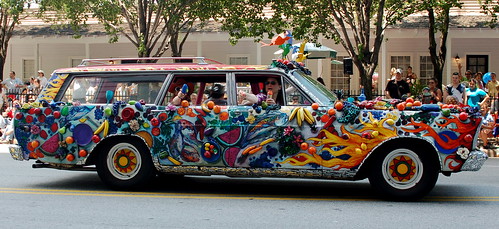
 " by Harrod Blank.I walked into the library one day and was browsing the car section when I came upon the most amazing book I had seen in a long time. In it was filled with images of people who had decorated their cars with paint, glued objects, car modifications and everything in between.
 Many of those cars have since been featured on Art Car Central like the Fruit Mobile, Hoop Car, Camera Van, The Phone Car, The Button King, Glass Quilt, and many more from Harrods Blanks Art Car Agency.


.jpg)

.jpg)


