Showing posts with label a16. Race Time Strategy. Show all posts

Saturday, October 31, 2009

Pit Stops Considerations

Here are the vital pieces of information the teams will take into consideration:
  • The way you qualify. Because fuel cannot be added or subtracted between Saturday qualifying and the race, the cars have to qualify with enough fuel on board to do the first stint of the race. Obviously a car planning to three-stop can qualify lighter than one on a two-stop strategy. The team needs to trade off the importance of qualifying position with the optimum race strategy.
  • The weight of fuel. This varies according to how dense the fuel is, but the regulations specify the density must be between 0.725 and 0.77kg per litre. The largest tanks hold around 150 litres and brimmed to capacity will therefore weigh around 120kg.
  • The amount of lap time this costs at the track in question. A half-tank car is quicker by around 2.4 seconds per lap around Suzuka than a full tank one, whereas over the similar distance of a Monza lap � with long straights and not many corners � the difference is only around 1.6 seconds. Suzuka therefore errs towards a two-stop strategy, Monza a one-stop.
  • The consumption of fuel. How much fuel (and therefore weight) needs to be put into the tank and how much the car sheds as it races tends to be higher at a track with lots of accelerating, braking, and use of the lower gears. The Hockenheim track, as revised from 2002, induces heavier fuel consumption than any other on the Formula One calendar. Although lap times at the track are only averagely sensitive to weight changes, the big reduction in weight (because of the high fuel consumption) means that the total effect is large. It�s therefore another track favouring a two-stop strategy. At the other end of the pole is Nurburgring where there is relatively gentle fuel consumption but where lap times are highly sensitive to weight. The net result is very similar, and again a two-stop is favoured.
  • Your qualifying position. If your grid position places you in an attacking position � meaning that you need to overtake other cars � you are more likely to opt for an aggressive two-stop strategy, even if the maths tells you that a one-stop is quicker. If it�s a track where pretty much everyone can be guaranteed to be on the same number of stops, you have a choice: depending on whether your strength is early or late in the stint, you can either short-fuel for the first stint, using your lower weight to pass cars and then hope to pull out enough of a time cushion before you stop to keep you ahead after they have stopped. Or you might choose to take on board as much fuel as you dare and hope you can keep up with cars that are lighter early in the race; when you stop later it will take less time as you will not spend as much time refuelling to get you to the end.
  • Other cars and overtaking opportunities. The more pit stops you make, the more you are at the mercy of traffic � of getting caught behind slower cars after your stop but before they make theirs. At a track with plenty of overtaking opportunities this is less of a consideration than at a place like Monaco where passing places are few and far between. The timing of your stop might also be influenced by traffic � for example, you might come in earlier than planned so as to avoid encountering a bunch of lapped cars.
  • How the brakes are wearing. At some circuits � such as Imola, Montreal and Monza � brake wear is extreme. A heavier fuel load places extra strain on the brakes, due to the extra weight and momentum that they are working against.
  • The skill of the driver. The handling balance of the car changes a lot from the beginning of a stint to the end. This change will be larger the longer the stint. Some drivers can cope with handling changes better than others, so it is something that has to be taken into account.

Choosing the number of stops


Pit stops are not actually compulsory in Formula One. In theory, a team could build a car with a big enough fuel tank to do the whole race without stopping, and the tyre manufacturers could easily produce a compound tough enough to make tyre changes a thing of the past. But in reality, such a car would be hopelessly off the pace. Not only would it be slow because of its weight and hard compound tyres, but the bulkiness arising from its big fuel tank would make the car aerodynamically inefficient, slowing it yet further � and all the other teams would laugh at them. All current Formula One cars are therefore designed around tanks that are too small to hold enough fuel to complete a full Grand Prix.
At most tracks, a pit stop � including slowing down, stopping, re-fuelling, and accelerating back up to speed � takes around 30 seconds. The race distance is specified as the least number of laps exceeding 305km (190 miles). (For more on what constitutes a �complete� race, head to �race stoppage� later in this chapter.) Over that distance, and with that time penalty, it did not use to be worthwhile stopping more than twice. But since the 2003 regulations prohibiting fuel loads being changed between qualifying and race (see Chapter 8), stopping three times in a race has become a viable option once grid position is taken into account. Stopping just the once, or even twice, during a race has fallen out of favour after the introduction of these regulations. At some tracks an extra stop is quite feasible, more than making up the extra 30 seconds of pit stop time with a lighter fuel load. Magny Cours, in France, with its very short pit lane and high tyre degradation, is a good example of this. At other tracks the tyres perform close to their peak for longer and the pit lane can be longer. Silverstone in Britain is a good example of this. The most common strategy in Magny Cours is three-stops, whereas for Silverstone two stops is more popular.
Aside from tyre behaviour, it�s all to do with fuel consumption and how much lap time the extra weight costs you. In other words, a team needs to know how sensitive the car�s lap time is to changes in weight and how fast that weight is changing.

Strategy on the hoof


Rarely has the importance of race strategy been so well demonstrated than at Monaco in 2002. Michelin, the tyre suppliers of Williams and McLaren, arrived with a tyre that was of supersoft compound, making it very quick over one lap in qualifying but less so over a race distance. The reasoning was to get at least one Michelin car to outqualify the dominant Bridgestone-shod Ferraris and then let the tight confines of the track aid them in keeping the red cars behind for the race.
It worked brilliantly, demoting Ferrari to the second row. In the race, McLaren�s David Coulthard soaked up pressure from Ferrari�s Michael Schumacher to take victory. Even though the Ferrari was capable of lapping more than 1 second per lap faster than the McLaren, there was simply no way by. In desperation, Ferrari brought Schumacher in a few laps early for his pit stop, in the hope he could use his speed to get and stay ahead when Coulthard stopped. When he rejoined, now on a clear track, he immediately set a stunning fastest lap. This alerted McLaren, who realised that, at this rate, Schumacher would indeed be able to pass when the McLaren stopped. Before any further damage was done, they brought Coulthard in early too, getting him out still ahead of Schumacher. It sealed the result.

Monday, August 31, 2009

Choosing Tyres in F1 Races


Teams can invest small fortunes (actually, make that very large fortunes) in developing race car technology, and drivers can be as brilliant as they like, but when it comes down to it, a car�s tyres are what actually keeps it moving on the track. So, as you might expect, development has crept into tyre design too! The teams are given a choice of two compounds of dry weather tyres from their supplier. The compound refers to the constituent mix of rubber and chemicals of the tyre. The compound choice will usually be between:
  • One that is more consistent and tougher-wearing
  • One that is made from a grippier chemical/rubber mix and therefore usually faster at its peak A team will prefer to be able to use the softer, initially grippier tyre but sometimes they are prevented from doing so if they cannot attune the car sufficiently so that the tyre�s wear rate is kept in check. In this case they will be forced to choose the harder compound.
The compound choice refers only to the dry weather tyres. The tyre company will supply wet weather tyres but there is no choice of compound for the teams to make.
The teams have to choose their dry weather compound before going out to qualify. They are stuck with that choice for the rest of the weekend, so a bit of forward planning is important. What compound they choose depends on the following:
  • The practice laps: The practices give the teams some indication of the wear rates and lap time capability of each tyre, enabling them to trade off one quality against the other in their calculations.
  • Info from the tyre manufacturers: The tyre manufacturers advise the teams after studying the practice data. This will include looking at the tyres� lap time drop off, the difference in performance at its peak and just before the pit stop. At some circuits, there is virtually no drop-off �meaning that the tyre is still at a peak performance level when the fuel stop is made. At others, notably circuits like Suzuka in Japan that have lots of long duration turns, it is a significant factor.
  • The pit stop strategy: The choice of tyre compound is also linked to the pit stop strategy. If you go for a one-stop strategy, the extra fuel weight may destroy the softer, more delicate compound and force you to opt for the harder, slower, choice.
  • The driver�s skill: Much depends upon the sensitivity and control of the driver. If he can �nurse� the car through the early stages when the car�s weight is high, he may be able to make even the softer tyre �live� and therefore get the benefit of its extra grip as the fuel load comes down. You hardly ever know before the race what tyre and pit stop strategy a driver has chosen, as obviously this is information that could be used to advantage by his rivals and is therefore kept close to the team�s chest. You can always try asking if you get close enough, but they might lie.

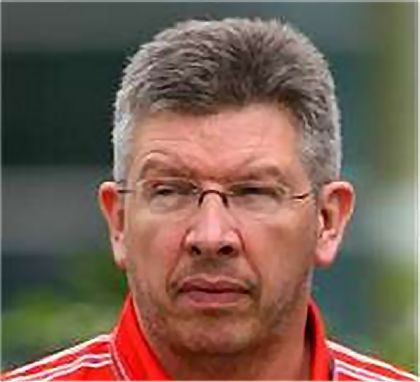
Ross Brawn � strategy master


Recognised as the greatest pit lane strategist in Formula One, Ross Brawn helped Michael Schumacher to all five of his World Championships, first at Benetton and subsequently at Ferrari.
A gifted designer in his own right, Brawn�s greatest period of success began when he took up the role of Technical Director and left the design chief role at Benetton to Rory Byrne. Brawn became more of an overseer and organiser, albeit one with the technical insight to work hand-in-hand with Byrne. This came just at the time that Formula One re-introduced refuelling �which had previously been banned � thus opening out new avenues of competitive advantage. Brawn exploited this brilliantly, frequently making rival teams look inept with his dazzlingly quick mind.
He was aided in his operations by the searing speed of Schumacher and when the latter left Benetton for Ferrari, it took only another year before Brawn and Byrne followed him there. The three have been the architects of Ferrari�s renaissance, and in 2000 Schumacher became the first Ferrari driver in 21 years to lift the world crown.

Deciding F1 Strategy


The two principal tools of pre-determined strategy are tyre choice and pit stop timing. Deciding whether to use hard or soft tyres and whether to stop once (meaning your race will comprise two stints) or twice (meaning three stints) and at what intervals are influenced by a two really important considerations:
  • Where you are in the field: Over the past few seasons Grand Prix grids have tended to be split into three sections: the top three teams, the midfield, and the lower orders. Barring freak circumstances there�s no way a midfield or tail-end team is going to threaten for victory, no matter how brilliant their strategy. �The competition� is usually a reference to the cars in your own group. A team that has qualified in the middle of the midfield looks at what strategy could get it to the front of the midfield by the end of the race, rather than trying to take on Ferrari, Williams, or McLaren for victory. Strategies are usually decided from that perspective. Is that negative thinking on their part? No, just realism.
  • How fast your pit stops are: For reasons of pit lane safety, highly pressurised refuelling � whereby fuel flows into the tanks at a very fast rate under pressure � is limited. The refuelling equipment fills the tanks at the rate of 12 litres per second. Barring problems, refuelling � and not tyre changing, which can be accomplished in around three seconds � is what determines the length of a pit stop. The tyre guys could even have a cigarette while waiting for the refuellers. . . no, on second thought. . .